Section I · The Japanese Candlestick Bible · Chapter 4
Context is everything
The same candle can be noise or a strong signal. The four pillars of context – trend, level, confirmation and timing – and the three-question rule.
Video lesson with voice-over and charts · 3 minEnglish subtitles
If you remember only one thing from this book, let it be this: a candle without context means nothing. A hammer in the middle of a choppy range is just a candle. The same hammer, formed at daily support after a prolonged decline, with a rejection of liquidity below a previous low – that is a signal with a real chance.
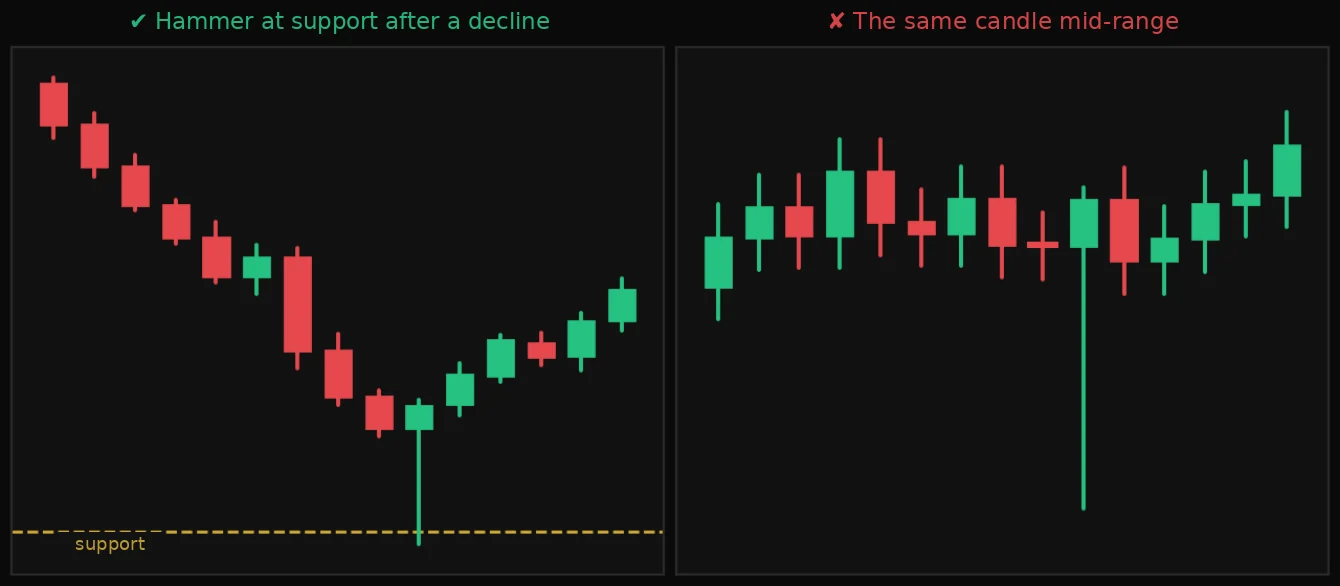
The four pillars of context
- Trend: reversal patterns need a trend to reverse. A bullish reversal pattern only makes sense after a decline, a bearish one – only after a rise. Continuation patterns work best in the direction of a strong trend.
- Level (location): support and resistance, previous highs and lows, round numbers (for gold – levels like 00 and 50), daily opens, supply and demand zones. A signal at a level > a signal in mid-air.
- Confirmation: the next candle must confirm the direction. Most false signals are filtered out simply by waiting one candle.
- Volume and timing: a pattern with increased volume or in an active session (London, New York) is more reliable than a pattern in a quiet Asian session.
How to identify the trend
The simplest method is price structure: uptrend = higher highs and higher lows (HH/HL); downtrend = lower highs and lower lows (LH/LL). In addition, you can use the 50- and 200-period moving averages: price above both and sloping up = uptrend.
The principle of confirmation
The Japanese say: “Wait for the close.” A candle isn't finished until it closes. A hammer that looks perfect 10 minutes before the end of the hour can turn into a bearish marubozu. Never trade an unclosed candle. On top of that, for most patterns it's sensible to also wait for the next candle to close in the direction of the signal.
The three-question rule. Before every candlestick trade, answer: 1) Where am I – is the pattern at a level? 2) What is the trend on the higher timeframe? 3) Is there confirmation? If any answer is “no” – skip the trade.
Exercises
Test yourself on the chart
0 of 4 correct
1A hammer appears in the middle of a choppy range. What does it mean?
2A small body at the top and a long lower wick – the shape of a hammer. But look at where it appears. Where is price more likely to go?
310 minutes before the end of the hour, the candle looks like a perfect hammer. What do you do?
4A small body at the bottom and a long upper wick – the shape of a shooting star. But what does it come after? Where is price more likely to go?
Key points
- A candle without context means nothing.
- Reversal patterns need a trend to reverse.
- A signal at a level is stronger than a signal “in mid-air”.
- Never trade a candle that hasn't closed – wait for the close and the confirmation.
- Three questions before every trade: level, higher-timeframe trend, confirmation.